Tuesday, October 16, 2012

Phylum Mollusca (6th Phylum)


The largest marine phylum, having around 93,000 species, molluscs have a great variety in terms of their anatomy, habitat and behavior. Most of the molluscs are categorized under the class 'gastropoda'. The major gastropods are snails and slugs. The word mollusc is derived from the French, 'mollusque'. This French word too was derived from the Latin word molluscus which means 'soft'. The important phylum mollusca habitats are oceans and freshwater. These are important creatures of the marine biome. Some of these creatures are however, terrestrial in nature. Let us have a look at various phylum mollusca characteristics in the following article.

Different Traits of Phylum Mollusca

Snails, clams and squids are important phylum mollusca examples. The phylum mollusca facts related to anatomy, physiology and other features are enlisted in the paragraphs below.

Anatomical Characteristics of Molluscs
The anatomy/structure of molluscs are complex in nature. One of the special features of their body structure is the presence of a coelom. The coelom is a cavity present in body of molluscs and which contains internal organs suspended from mesenteries. Let us find out more information about the anatomical characteristics of molluscs.
The upper surface of molluscs is covered by a shell formed from secretions of mantle. A muscular foot is present on underside of the body.
The mantle cavity is a body part of molluscs formed by the fold produced in the mantle. Position of the mantle varies from one species to other.
Different organs present in the mantle cavity include the reproductive organs (gonads), gills, kidneys (nephridia) and the anus. The anus is formed of chemical sensors called osphradia.
The shells of molluscs are formed of calcium carbonate (95%) and organic components (1%). Biomineralization is a special feature of mollusc shells which give them the necessary strength.
The feet of the molluscs carry out different functions in different classes. A balance organ called statocyst is incorporated in the foot structure of molluscs.
In limpets, the foot is modified into a sucker which helps in anchoring the animal to hard surfaces.
The foot in the gastropods secrete mucus to facilitate movement.
Physiological Characteristics of Molluscs
The facts presented below reveal interesting information about the characteristics of phylum mollusca that are physiological in nature.

Locomotion
There is great diversity among molluscs in terms of locomotory organs. Most of the molluscs move from one place to other by means of muscular contraction. The herbivorous species glide over waves of water. The undulating lateral fins of the cuttlefish enables it to move by performing maneuvers. A jet propulsion technique is used by cephalopods for swimming rapidly in water.

Digestive and Excretory Functions
The stomach of molluscs are complicated in structure. The mouth and the anus form the parts of digestive and excretory system; these parts are connected to each other by the complex stomach. The entire digestive tract is lined by cilia. Absorption of food from the digestive tract is done by cells aligned with digestive glands in the stomach; nutrients absorbed from this food, then enter the blood. Waste or undigested materials are excreted through the anus. The waste materials before excretion are compressed and packaged in a solid form; before reaching the anus these undigested materials are stored in the mantle cavity.

Phylum Mollusca Reproduction
Reproduction of molluscs takes place by means of external fertilization, through which eggs are produced. There is a lot of variation in types of larvae that emerge from eggs. Larvae could be the trochopore, veliger or in some cases even miniature adults are produced directly.

Nervous and Sensory System of Molluscs
Molluscs have a highly developed nervous system which varies from species to species. The octopus has such a complex and intelligent brain that its mental abilities match that of a domestic cat. Thus, it is deemed as the most intelligent invertebrate. Squids are capable of locating transparent creatures by means of polarized vision. The giant squid is known to have biggest eyes in the entire animal kingdom.

There is a lot to say about these sea creatures, the molluscs. Variety in their forms, body features, etc. has been studied to reveal interesting information about molluscs. The phylum mollusca characteristics presented above thus, provides brief information about these creatures.
The largest marine phylum, having around 93,000 species, molluscs have a great variety in terms of their anatomy, habitat and behavior. Most of the molluscs are categorized under the class 'gastropoda'. The major gastropods are snails and slugs. The word mollusc is derived from the French, 'mollusque'. This French word too was derived from the Latin word molluscus which means 'soft'. The important phylum mollusca habitats are oceans and freshwater. These are important creatures of the marine biome. Some of these creatures are however, terrestrial in nature. Let us have a look at various phylum mollusca characteristics in the following article.

Different Traits of Phylum Mollusca

Snails, clams and squids are important phylum mollusca examples. The phylum mollusca facts related to anatomy, physiology and other features are enlisted in the paragraphs below.

Anatomical Characteristics of Molluscs
The anatomy/structure of molluscs are complex in nature. One of the special features of their body structure is the presence of a coelom. The coelom is a cavity present in body of molluscs and which contains internal organs suspended from mesenteries. Let us find out more information about the anatomical characteristics of molluscs.
The upper surface of molluscs is covered by a shell formed from secretions of mantle. A muscular foot is present on underside of the body.
The mantle cavity is a body part of molluscs formed by the fold produced in the mantle. Position of the mantle varies from one species to other.
Different organs present in the mantle cavity include the reproductive organs (gonads), gills, kidneys (nephridia) and the anus. The anus is formed of chemical sensors called osphradia.
The shells of molluscs are formed of calcium carbonate (95%) and organic components (1%). Biomineralization is a special feature of mollusc shells which give them the necessary strength.
The feet of the molluscs carry out different functions in different classes. A balance organ called statocyst is incorporated in the foot structure of molluscs.
In limpets, the foot is modified into a sucker which helps in anchoring the animal to hard surfaces.
The foot in the gastropods secrete mucus to facilitate movement.
Physiological Characteristics of Molluscs
The facts presented below reveal interesting information about the characteristics of phylum mollusca that are physiological in nature.

Locomotion
There is great diversity among molluscs in terms of locomotory organs. Most of the molluscs move from one place to other by means of muscular contraction. The herbivorous species glide over waves of water. The undulating lateral fins of the cuttlefish enables it to move by performing maneuvers. A jet propulsion technique is used by cephalopods for swimming rapidly in water.

Digestive and Excretory Functions
The stomach of molluscs are complicated in structure. The mouth and the anus form the parts of digestive and excretory system; these parts are connected to each other by the complex stomach. The entire digestive tract is lined by cilia. Absorption of food from the digestive tract is done by cells aligned with digestive glands in the stomach; nutrients absorbed from this food, then enter the blood. Waste or undigested materials are excreted through the anus. The waste materials before excretion are compressed and packaged in a solid form; before reaching the anus these undigested materials are stored in the mantle cavity.

Phylum Mollusca Reproduction
Reproduction of molluscs takes place by means of external fertilization, through which eggs are produced. There is a lot of variation in types of larvae that emerge from eggs. Larvae could be the trochopore, veliger or in some cases even miniature adults are produced directly.

Nervous and Sensory System of Molluscs
Molluscs have a highly developed nervous system which varies from species to species. The octopus has such a complex and intelligent brain that its mental abilities match that of a domestic cat. Thus, it is deemed as the most intelligent invertebrate. Squids are capable of locating transparent creatures by means of polarized vision. The giant squid is known to have biggest eyes in the entire animal kingdom.

There is a lot to say about these sea creatures, the molluscs. Variety in their forms, body features, etc. has been studied to reveal interesting information about molluscs. The phylum mollusca characteristics presented above thus, provides brief information about these creatures.

Phylum Annelida (5th Phylum)


  • Free-living, terrestrial or aquatic form (freshwater or marine).
  • Body is long, cylindrical and metamerically segmented.
  • Body wall consists of cuticle, epidermis and musculature.
  • Body cavity is a true coelom, lined by epithelium.
  • Digestive system is complete.
  • Respiration is either through skin or through gills.
  • Excretion with the help of characteristic nephridia.
  • Presence of a circulatory system (closed type). Hemoglobin dissolved directly in the plasma.
  • Nervous system consists of a nerve ring and a double ventral nerve cord with segmental ganglia.
  • Locomotion with the help of setae or parapodia.
  • Reproduction by sexual methods. Either unisexual or bisexual development may be direct or indirect.
  • Body has a true coelom.
           fig. 10.13 - Examples of Annelida
The phylum is divided into four classes
 Characteristics Class Polychaeta Class Oligochaeta Class Hirudinea Class Archi annelida
 Habit and habitat Free living marine Free living forms found in most soil Fresh water forms Temporary ectoparasites Marine forms
 Locomotor Structure Parapodia Setae Absent Absent
 Lifecyle Unisexual with indirect development Bisexual with direct development Bisexual with direct development Bisexual with indirect development
 Examples Nereis (reg worm) Pheretima, Megasolex (earth worms) Hirudinaria (leech) Polygrdius
 
fig. 10.14 - Anterior Segments of Nereis
                fig. 10.15 - Earthworm Anatomy


Phylum Nematoda (4th Phylum)


There are thousands of nematodes. Not only are there more than 15,000 known species of roundworms, but there are many thousands of individual nematodes in even a single handful of garden soil. And they keep coming! Some species of roundworm may contain more than 27 million eggs at one time and lay more than 200,000 of them in a single day. Some scientists have estimated that there may be as many as half a million more unkown species of roundworm yet to be discovered, an estimate based on the fact that many new species are still being discovered, that relatively few people are looking for more species, and that most roundworms look pretty much alike. If the estimated number of species is anywhere close to correct, it would mean that roundworms are the second most diverse group of animals, trailing behind only the arthropods.
Nematodes were once classified with a very large and heterogeneous cluster of animals grouped together on the basis of their overall worm-like appearance, simple structure of an internal body cavity called apseudocoelom, and the lack of features such as cilia and a well-defined head that are found in most animals. This group, variously known as Aschelminths or Pseudocoelomata, is today no longer recognized as a natural one. It is quite likely that the simple body plan of these organisms has resulted from reduction and simplification from more than one group of ancestral organisms, and so the pseudocoelom is neither a uniquely derived nor useful character. (Wallace, Ricci, & Malone 1996) The simplicity is thus a result of secondary simplification from a more complex body design, and not necessarily an indication of primitive or simple origins. Current studies indicate that nematodes are actually related to the arthropods and priapulids in a newly recognized group, the Ecdysozoa.


nematode micrographNematode cross-section
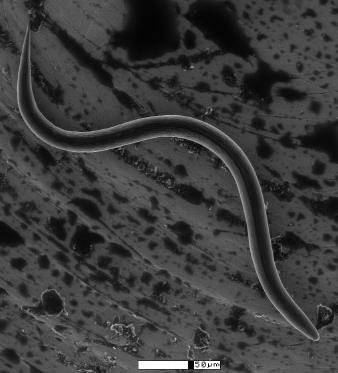
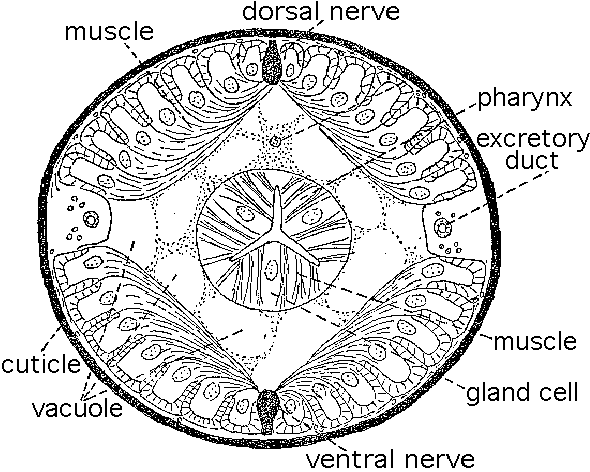
Roundworms : The image at left shows a living microscopic roundworm as viewed with an Environmental SEM. The worm is approximately one millimeter long. At right, a diagrammatic view of the internal anatomy of a roundworm, showing the simplicity of its organization. See text below for discussion. (Click on either of the pictures above for a larger image).

The body of a nematode is long and narrow, resembling a tiny thread in many cases, and this is the origin of the group's name. The word "nematode" comes from a Greek word nema that means "thread". Theepidermis (skin) of a nematode is highly unusual; it is not composed of cells like other animals, but instead is a mass of cellular material and nuclei without separate membranes. This epidermis secretes a thick outer cuticle which is both tough and flexible. The cuticle is a feature shared with arthropods and other ecdysozoans. As in those other groups, the cuticle is periodically shed during the life of a nematode as it grows, usually four times before reaching the adult stage. The cuticle is the closest thing a roundworm has to a skeleton, and in fact the worm uses its cuticle as a support and leverage point for movement. Long muscles lie just underneath the epidermis. These muscles are all aligned longitudinally along the inside of the body, so the nematode can only bend its body from side to side, not crawl or lift itself. A free-swimming roundworm thus looks rather like it is thrashing about aimlessly.
The muscles are activated by two nerves that run the length of the nematode on both the dorsal (back) and ventral (belly) side. Unlike other animals, where the nerves branch out to the muscle cells, a nematode's muscle cells branch toward the nerves. The ventral nerve has a series of nerve centers along its length, and both nerves connect to a nerve ring and additional nerve centers located near the head.
The head of a nematode has a few tiny sense organs, and a mouth opening into a muscular pharynx (throat) where food is pulled in and crushed. This leads into a long simple gut cavity lacking any muscles, and then to an anus near the tip of the body. Food digested in the gut is not distributed by any specialized vascular system, and neither is there a respiratory system for the uptake or distribution of oxygen. Rather, nutrients and waste are distributed in the body cavity, whose contents are regulated by an excretory canal along each side of the body.
Many nematodes are able to suspend their life processes completely when conditions become unfavorable; in these resistant states they can survive extreme drying, heat, or cold, and then return to life when favorable conditions return. This is known as cryptobiosis, and is a feature nematodes share with rotifers and tardigrades.
Fossil nematodes have been found in rocks from as early as the Carboniferous. Most living roundworms are microscopic, meaning that their discovery as fossils is likely to be difficult. On the other hand, one species of parasitic nematode can reach 13 meters in length -- it parasitizes the sperm whale. Nematodes also lack any substantial hard parts, again resulting in a spotty chance for fossilization. Despite these problems, fossil nematodes are occasionally found in amber (fossilized tree resin) from the Cenozoic. Because many of their relatives have left fossils dating from the Cambrian, it is likely that the nematodes have been around at least that long in some form.
If you've wandered around our exhibits much, you've seen many groups described as living just about anywhere. That statement goes triple for nematodes, who live not only in almost every geographic location on Earth, but live in such extreme habitats as ice and hot springs, as well as living on or in almost every other kind of animal and plant alive today. Free-living nematodes are extremely abundant in soils and sediments, where they feed on bacteria and detritus. Other nematodes are plant parasites and may cause disease in economically important crops. Still others parasitize animals (including humans); well-known parasitic nematodes include hookworms, pinworms, Guinea worm (genus Dracunculus), and intestinal roundworms (genus Ascaris).

Phylum Platyhelmithes (3rd Phylum)


Lowest of the worms are Platyhelminthes. The have thin soft bodies. This phylum includes three classes:
Turbellaria (free-living flatworms) most of which enhabit fresh water, saltwater or moist places on land.
Trematoda (flukes). External or internal parasites.
Cestoda (Tapeworms) the adults of which are intestinal parasites of vertebrates.
Some of these parasites cause serious illness or death to their hosts.


Characteristics:

1. Symmetry bilateral. Three germ layers (triploblastic). Body usually flattened dorsoventrally. No true segmentation.

2. Epidermis soft and ciliated(turbelaria), or covered with cuticule and with external suckers or hooks, or both for connection to host (Trematoda, Cestoda).

3. Digestive system incomplete (a mouth but no anus) and usually much branched. None in Acoela or Cestoda.

4. Muscle layers well developed. No body cavity. Spaces between internal organs filled by loose parenchyma.

5. No skeletal, ciculatory or respiratory systems. Excretory system with many flame cells connected to excretory ducts (protonephridia).

6. The nervous system is a pair of anterior ganglia or a nerve ring connected to 1 - 3 pairs of longitudinal nerve chords with transverse commissures.

7. The sexes are usually united (monoecious). Reproductive system of each sex with gonads, ducts, and accessory organs. Fertilization occurs internally. The eggs are microscopic, each enclosed with several yolk cells in a shell. The development in its life cycle is either direct (some Turbellaria and monogenetic Trematoda) or with one or more larval stages (digenetic Trematoda and some Turbellaria and Cestoda). Asexual in some species.


Only Turbellaria (free-living flatworms) are dealt with here.


Flatworms have simple, flattened, leaf-like bodies and glide along on a bed of fine hairs or by ripples of contracting muscles.

A marine flatworm with tenacles.


A flexible tubular proboscis traps prey such as small crustaceans and molluscs. The digestive canal ends blindly without any anus.
Cross section of the body at the level of the pharynx.

Lateral view of a generalized tuberlarian.
Flatworms are hermafroditic, but cross fertilise. Partners then lay strings of large yolky eggs.

Prostheceraeus bellostriatus : A marine flatworm.

Phylum Coelenterata/ Coelenterates (2nd Phylum)


  • Radially symmetrical, diploblastic multicellular animals with a tissue grade of organisation.
  • Aquatic, freshwater or marine solitary or colonial forms which may be free swimming or sedentary.
  • Body has a mouth at the oral end which leads into a spacious cavity called gastrovascular cavity or coelenteron.
  • Presence of long, hollow structures called tentacles used for locomotion and food capturing.
  • Presence of peculiar type of cells called cnidoblasts, nematocysts or stinging cells in the ectoderm, especially in the tentacles, used for offence and defence.
  • Digestion is both intracellular and extracellular.
  • Respiration and excretion by simple diffusion.
  • Presence of a network of nerves spread all over the body.
  • Many forms exhibit polymorphism, wherein different types of individuals are present in a colony for different functions. These individuals are called Zooids.
  • Reproduction asexually (external budding) or sexually (formation of gametes).
    fig. 10.7 - Examples of Coelenterata
The phylum is divided into three classes
CharacteristicsClass HydrozoaClass SchyphozoaClass Anthozoa
HabitatFresh water or marineMarineMarine
Body FormPolypoid or MedusoidMedusoidPolypoid
ExampleHydra, Obelia Physalia (Portuguese man of war)Aurelia Cassoprea (Jelly fishes)Sea anemone Astrea Fungia and other Corals

                    fig. 10.8 - Anatomy of Hydra
TYPES  POLYMORPHIC FORMS IN CNIDARIANS: (COELENTERATA_)
  There are three types of polymorphism  (polymorphic forms) found in the Cnidarians-(Obelia sp.) The class Anthozoa consists only of  polypoid forms.
POLYPOID  FORMS  OF CNIDARIAN   POLYMORHISM 
  • The polypoid form or the polyp is the hydroid form, generally sessile .
  •  Body cylindrical hollow with a common stem of colony by proximal end .
  • The distal; end with a conical elevation called manubrium or oval cone with tentacles at its base in a circle.
  • Both body and manubrium contain coelenteron with a mouth at the top of the manubrium
  • .Body composed of  epidermis and gastrodermis with mesoglea inbetween.
  • Tentacles, manibrium and polyp wall well provided with muscular cells for contraction
  • .Cnidoblast cells with nematocysts  in tentacles                                                                                                                                                                                                                             Polymorphism CoelenterataPolymorphism Coelenterata                                                         Obelia  colony                                                        SIngle polyp,magified   

                                                      
                     Polymorphism Coelenterata                  nematocyst                                                                      
                           CNIDOBLAST CELL                                                   DISCHARGED CNIDOBALST    


Phylum Porifera (1st Phylum)

The Phylum Porifera contains the sponges. There are approximately 6000 sponges. Most live attached to marine reefs. Approximately 100 species live in freshwater. They lack true tissue and organs and therefore the cells are relatively unspecialised. Sponges often have complex life histories. Some species are free standing whilst others form an encrusting layer over rocks.
Sponges are filter feeders. The surface of the sponge has many pores (ostia) through which water is drawn into the body. The water is drawn into a series of canals and chambers where food particles (plankton) are trapped. The water then passes out of the body through larger pores (oscules). A sponge can pump hundreds of litres through it's body each day.
Being filter feeders, sponges live most successfully in areas with strong currents or wave action. They grow less rapidly than seaweeds, therefore are less common in shallow sunny reefs.
A few specialised opisthobranchs (sea slugs), crustaceans, echinoderms and fish are known to feed on sponges.
Most carnivorous animals avoid sponges because of the splinter-like spicules and toxic chemicals produced by the sponge.
SPONGES AT THE MDC
The following species of sponge are found at the Marine Discovery Centre:

  •  Tethya sp. ? - Pumpkin sponge

  • Tethya sp. ? - Pumpkin Sponge
    Picture: MDC
    Habitat: Reef, sand, muddy bottom; 2 - 15 m depth
    Distribution: Unknown due to lack of taxonomic resolution
    Maximum size: Up to approximately 300 mm diameter
    Diet: Plankton (filter feeder)
    Comments: 
    Staff at the Marine Discovery Centre find Pumpkin Sponges commonly in the D'Entrecasteaux Channel, often hauling them up with the dredge. Sponges often form what's called a "Sponge Garden" where large numbers of sponges can be found.

  • Carteriospongia caliciformis - Plate Sponge

  • Carteriospongia caliciformis - Plate Sponge
    Picture: MDC
    Habitat: Moderately exposed reef, 5 - 35 m depth
    Distribution: SA to Victoria and around Tasmania
    Maximum size: Up to approximately 300 mm diameter
    Diet: Plankton (filter feeder)
    Comments: 
    This species lacks spicules and only has spongin for support. It occurs commonly on deeper reefs in areas of high current flow. The irregular green colour of the sponge may be caused by green symbiotic algae growing on the surface. 

  • Dendrilla rosea - Rosea Sponge

  • Dendrilla rosea - Rosea Sponge
    Picture: MDC
    Habitat: Moderately exposed reef, 3 - 22 m depth
    Distribution: SA to NSW and around Tasmania
    Maximum Size: Length to 400 mm
    Diet: Plankton (filter feeder)
    Comments: 
    Bright pink sponge with deeply ruffled surface. Can be erect or encrusting.

  • Siphonochalina sp. ? - Finger Sponge

  • Siphonochalina sp. ? - Finger Sponge
    Picture: MDC
    Habitat: Exposed reef, 20 - 35 m depth
    Distribution: Eastern Tasmania
    Maximum size: Length to 150 mm
    Diet: Plankton (filter feeder)
    Comments: 
    This species has long tubular extensions (fingers!). Common on deep Tasmanian reefs.